Getting 4,000€ checks from day 1 with a no-code product
For broader context, this post is Chapter I of the Why Cyrius Failed series.
Table of contents
- Spotting the cybersecurity gap
- Building the first version of the product
- A first business opportunity
- Hustling for early customers
- Transitioning from students to full-time entrepreneurs
Lessons learned
- #1 - Understand the importance of founder-market fit.
- #2 - Friends are bad advisors.
- #3 - When unsure where to start, go and ask people.
- #4 - Be mindful about your first customers.
- #5 - "Founder magic" should be enough to find the 10 first customers.
- #6 - PoCs are paid.
- Then you have a deal, the client said.
- Amazing, I answered, here is my RIB for the payment.
- But this is a personal RIB… Don’t you guys have a corporate bank account?
- Well, no… not yet :)
And here we signed our first customer.
But let's get back to the beginning of the journey.
Every start-up begins with a dream. For me, that dream started in September 2020, when I began my Master's in Entrepreneurship at a top business school in France.
I was a young idealist with ambitions of becoming a businessman. My -thin- background was in fashion and finance, with no knowledge of tech.
Spotting the cybersecurity gap
I started the year full of motivation and teamed up with two smart and cool classmates. After numerous brainstorming sessions, we decided on cybersecurity - a field we knew little about, without any contacts or technical background.
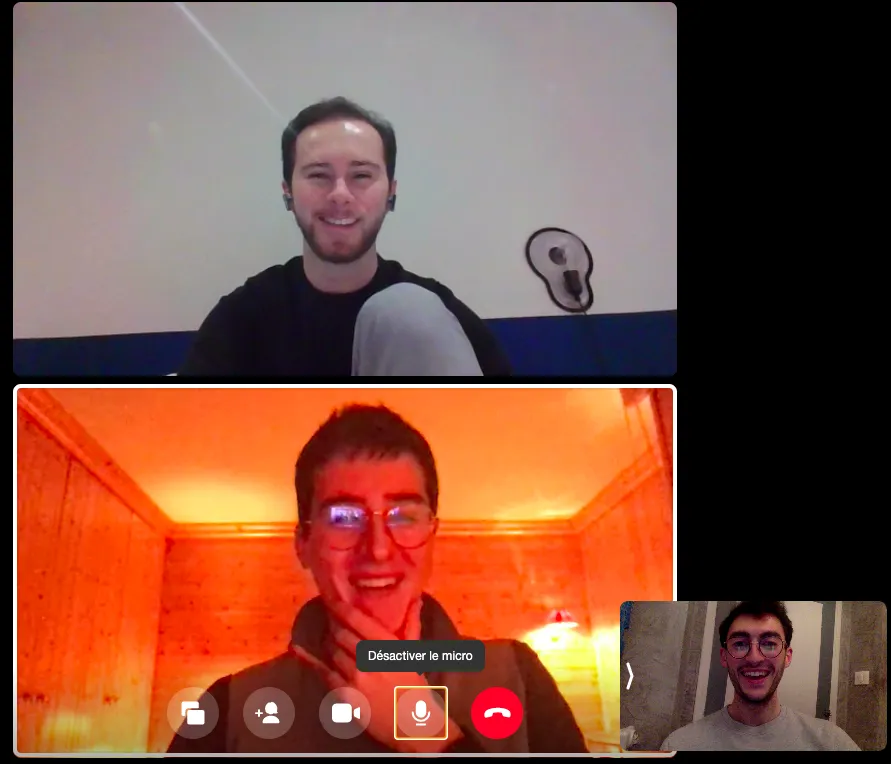
Month 0 - Creating a company in Covid times
Why cybersecurity? It seemed like a promising market with significant needs and opportunities. As business students, we thought a good time to market and a proper execution would be enough to make it.
We investigated the industry, exploring the idea of bug bounty and even speaking with hackers on Twitter for insights. A press article highlighting the need for cybersecurity awareness training eventually caught our attention, and we knew we were onto something.
Our reasoning was simple: "Cybersecurity needs are growing, making the market size and timing ideal. We cannot compete with technical profiles to create the next-gen anti-virus software, but we can educate others about cyber threats."
LESSON #1: Understand the importance of founder-market fit.
Our initial market choice was almost random. Success is much harder when you lack knowledge and skills in a technical field. In other words, we lacked "founder-market fit", which is the #1 thing to look for in the industry you pick. There are exceptions, but be prepared to spend 5–10 years in your chosen market.
Cybersecurity seems complex and intimidating for most employees. At that time, most security awareness training software was dull and patronizing (think compliance mandatory training). We thought, "There must be a better way - a friendly, engaging format that people would enjoy."
Building the first version of the product
This led to the creation of our first product: a fun chatbot designed to engage employees in cybersecurity discussions. It was a "shower idea" from one of my co-founders, built entirely with no-code tools.
Back in 2020, chatbots were not smart at all, so we would have to manually create all possible answer flows. To move quickly and capitalize on the momentum, we crafted the first module on a Sunday afternoon and shared it as a Messenger bot with friends the next day.
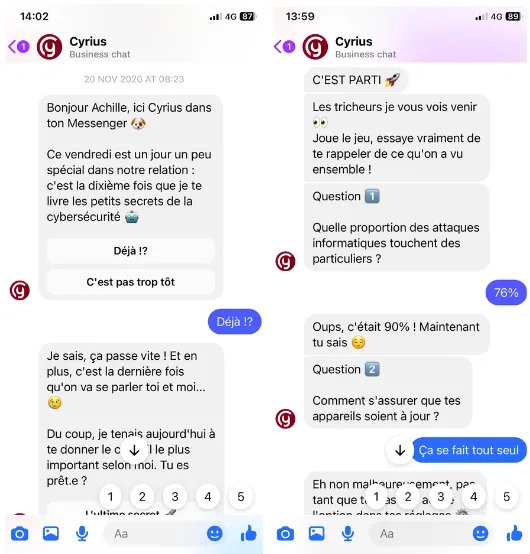
Month 1 - The bot teaching cybersecurity. Even in French you can feel the mood of the conversation with the emojis and tone.
For two weeks, we worked like crazy to deliver a new, 5-minute module every morning. It was amazing to put the first version of the product in the hands of someone.
Now that I think about it, it was probably a terrible way of validating the market (we've read the Mom Test since) but let's say we had nice friends. They provided us with feedback and enough drive to pursue our newfound business idea.
LESSON #2: Friends are bad advisors.
Your friends/relatives will never say they don't like your product, because they like you. They can be useful for helping you see a different perspective and emotional support - which are both great. But don't use them to validate anything. Learn to ask the right questions, read the Mom Test.
Since the MVP went "well", we wanted to test it with an real company as soon as possible. We chose to target SMBs over enterprises initially, feeling more legitimate starting small.
We scrapped a couple of hundred small businesses from LinkedIn, ranging from car sellers to medical centers. We called them one by one to ask about their cybersecurity knowledge. Their answer 100% of the time? "I have no idea what you are talking about, kid".
Great. At least we knew we would not start with that segment.
LESSON #3: When unsure where to start, go and ask people.
In our case, we had no other choice! Call, email, knock on doors, ask for intros, whatever. Be nice, show people they can help, and they'll share what you need to know.
A first business opportunity
Luckily, an opportunity emerged: one of our co-founder's dad was working at a big public works firm discussing how to strengthen their cyber arsenal. They had no security training yet and were willing to try our innovative format.
Perfect timing gave us our first real-world Proof of Concept (PoC) with 300 employees.
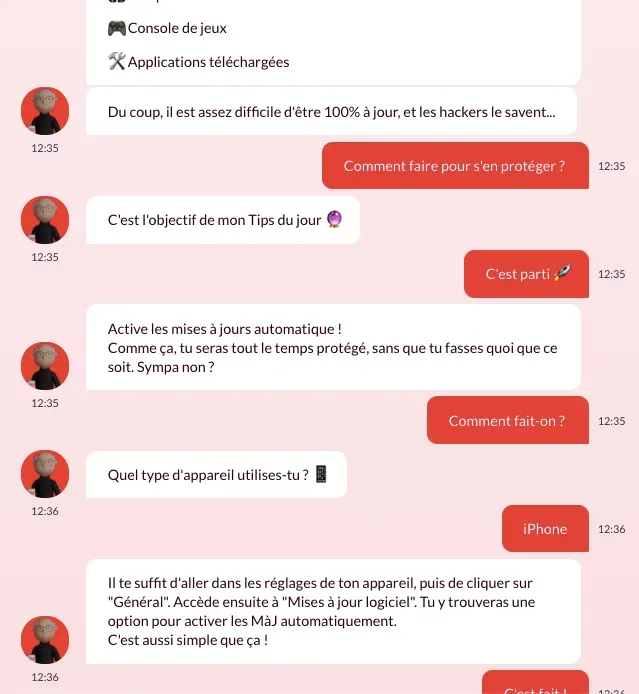
Month 2 - "If you're not ashamed of the first version of your product, you launched too late", they say. We clearly didn't launch too late 🫣
The test lasted 2 weeks. We spent a lot of time after that to conduct qualitative interviews with the users to understand as deeply as possible what they liked or not.
The feedback was great overall, the experience had been a success on their side. We were thrilled.
It was December already. We came back home for the holiday break, scheduling a debrief meeting with the CIO of the company just before Christmas. We were extremely stressed - this could make or break us.
When we finally met, he asked us if we could handle their large volume of users. I confidently assured him that we could manage, eager to seize the opportunity. "Then you have a deal", he said, "we will start with a business unit from January the 4th."
We could not believe it! The first company that tried out our tool was willing to pay for it.
It was an exhilarating moment I will never forget.
LESSON #4: Be mindful about your first customers.
While landing a big client early in your journey can be validating, it can also create unrealistic expectations and pressures. In retrospect, accepting this huge deal made us think we had figured it all, whether it was mostly luck.
Make sure you want both the check and the problems associated with the clients you choose to serve (eg. developing corporate features such as security, etc). I know how hard it is to gain these first contracts, that is why it is crucial to make the most of them while following your original vision.
We started sending our cybersecurity training modules to that client at the beginning of the following year. One memorable moment was receiving our first payment of 4,000€ in my personal account because we didn't have a professional bank account yet.
We moved quickly, picking a company name in a week and designing a logo in a few hours. Both remained unchanged until the end, consistently receiving praise. Don't overthink what can be changed later!
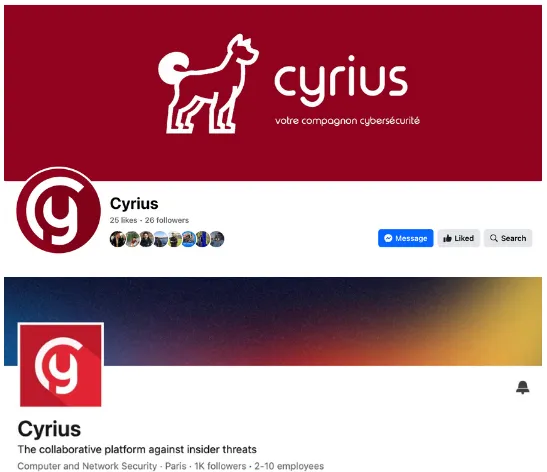
The first version of the name and logo on Facebook (Month 2) VS the last on LinkedIn (Year 3). Didn't change much.
Hustling for early customers
When we charged another client 5,000€, I remember calling my dad and asking him:
"I cannot believe these people want to pay us that much money. What if they don't like the product, or we fail to provide them what they ask for?"
"I trust you will do whatever it takes to fulfill the contract", he answered.
Not sure it made me feel less afraid, but at least I accepted the check.

Month 6 - Our very first payment!
We were still students at that time, it was super fun to juggle between theoretical classes and building the company.
I was in charge of business development. So I began contacting tons of people on LinkedIn, both to understand how the security industry worked and to promote our product.
I remember vividly my very first meeting.
It was with a CISO (Chier Information Security Officer) who asked me if we had a security policy. Our company was only a few weeks old, and I didn't even know what the acronym meant! I googled it as we talked and said it was a work in progress.
We got ourselves an actual policy a few months later after clients kept asking us for one.
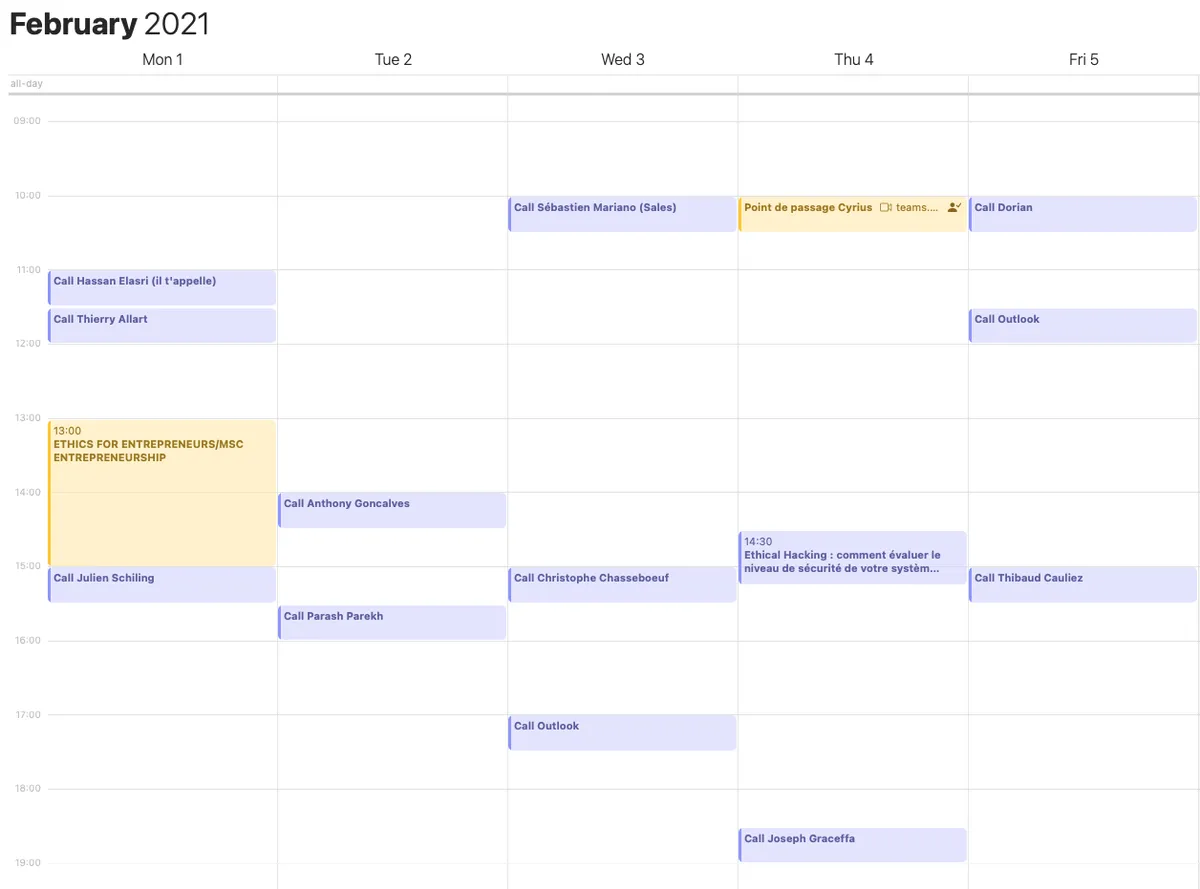
Month 6 - A typical week at that time: in purple the professional meetings, in yellow the school courses.
Acquisition at that time was only outbound (i.e. me contacting people rather than them coming to me) since I had no pre-existing network in security.
I learned business development the hard way: segmentation, prospecting, copywriting, email sequences, cold calling, CRM, and more.
I put my hand on every tool available. I took online courses on the sales process. It was an extraordinarily enriching process, extremely hard too. I contacted hundreds, thousands of people, with almost no answers.
It was mentally draining. Over time, I got better and figured out a few things.
LESSON #5: "Founder magic" should be enough to find the 10 first customers.
To get your first customers, you do not need dozens of tools or a complex sales book. What you need is making enough noise until you find one person willing to pay for what you sell. You can make noise by posting on social media, picking up the phone, being introduced...
What matters is finding one person, and "overserving" that person. Ensure you deliver exceptional value and service so that they recommend you to a friend. This creates momentum and gets your flywheel running. That is all at the beginning.
Meanwhile, my associates worked to improve the product based on potential customer feedback. We upgraded the UI/UX of the chatbot and added an admin dashboard.
Our relentless prospecting and product development started to pay off. We set up PoCs with half a dozen prospects and ended up with 2 more customers before summer.
Over the years, we implemented over 30 trials, taking a long time to get it right.
LESSON #6: PoCs are paid.
Free trials or PoCs can be traps unless part of a real freemium strategy. Charge for PoCs, even a small amount, to ensure prospects are serious. Otherwise, you just sell yourself cheap, and you authorize half-interested people to steal your energy.
Trials are a must-have for most mid-market or enterprise sales. When you do need a PoC to convince your customer, make the steps adamant. Clearly define goals, success conditions, and timelines. Schedule follow-up meetings before starting. If a prospect refuses, they aren't interested enough.
Transitioning from students to full-time entrepreneurs
A big step in our journey was the transition from a school project to a company on our own.
I honestly never considered dropping out (please don't show this to my biography's future writer) and going full-time that early, mainly because it was easy to check the boxes at school.
That's why I chose this Master's in the first place. We were doing the bare minimum to pass exams, but we were still feeling like we needed to be supported in a way.
Luckily, our business school has a partnership with the largest startup campus in the world: Station F. They have their startup accelerator there called EDHEC Entrepreneurs, with special perks for students and alumni.
Joining the accelerator was a logical next step. We were dreaming of entering Station F - it is the place you want to be in as a wannabe entrepreneur.
So when the application opened to join the incubator, we applied with very high hopes.
Getting in would be a huge step toward the realization of my dream. If not, we thought we would die.
The application process was stressful, but we gave it our all and…
We got in.
WE GOT IN!
I can still remember the moment I called my parents to share the news. My mom cried with joy for me. It was a big deal.
We would move from a small city in northern France to Paris, at the heart of one of the biggest start-up ecosystems in Europe.
We would work in an open space full of fellow entrepreneurs, instead of my living room.
It was a dream becoming true.
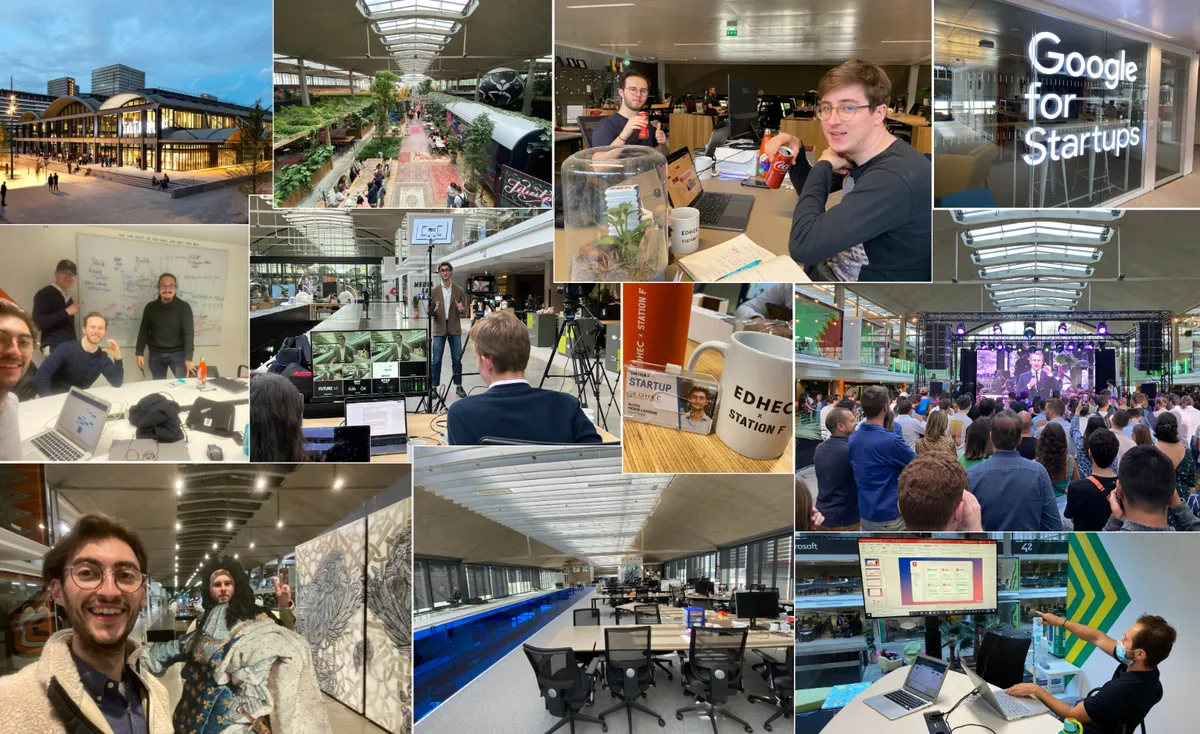
Year 1 to 2 - Station F is truly special
As we transitioned from a school project to a full-time startup, our journey was just beginning. With our first real clients and a seat at an accelerator, we felt unstoppable.
But the road ahead was filled with new challenges and lessons. If you're interested in how we closed a six-figure deal and found our first recruits and CTO, stay tuned.
The rollercoaster ride continues in Chapter II!