How to shut down a company: Finding acquirers & dealing with debt
For broader context, this post is the epilogue to the Why Cyrius Failed series.
Recap of the previous parts: We launched our cybersecurity startup while still at school, using no-code tools, and transitioned from a school project to a full-time venture (Chapter I).
With our first clients on board, we brought on interns, secured our first major contract (+100k€), and hired a CTO (Chapter II).
We then gained enough traction to reach 20k€ MRR and ultimately raise 700k€ in financing to fuel our growth (Chapter III).
With new funding, we expanded our team to 10 members and navigated the challenges of scaling, but faced tough competition and difficulties to sell (Chapter IV).
We eventually realized that we were running out of options and had to let the team go. After multiple attempts to pivot, my remaining co-founder and I decided to sell the platform and sunset the company (Chapter V).
But as we discovered, even shutting down a startup is not as easy as it sounds.
Table of contents
- Trying to sell
- Discontinuing a company when you have debts
- Was it worth it?
Lessons learned
- #27: Don't sell a company, sell a story
- #28: A wrap-up
Trying to sell
As hard as it was to wave Cyrius goodbye, we still had to make something out of the work we had been putting in for years.
I opened my CRM and LinkedIn network and started to reach out to everyone who could be remotely interested in acquiring cyber awareness tech.
Consulting firms, other vendors, insurance companies, brokers, and even funds: I went to great lengths to make sure I was not missing any opportunity. I asked for intros and followed up too many times surely, but that was too important.
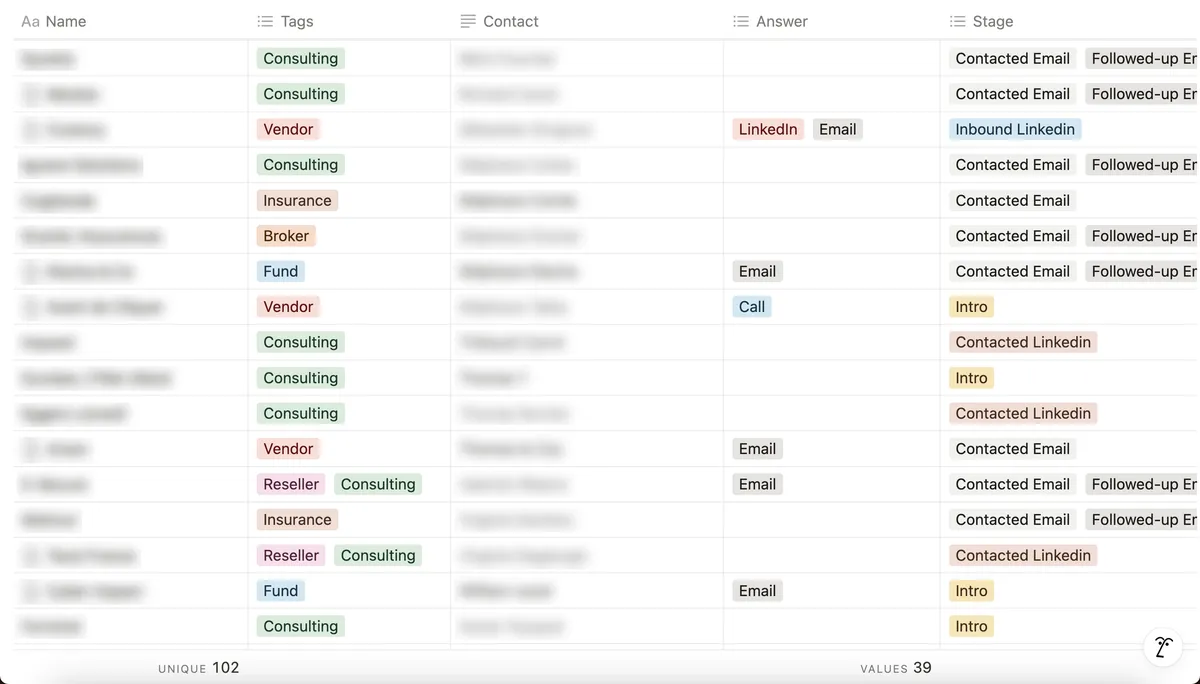 Year 4 - Almost 40 answers on 100+ contacts.
Overall I reached out to 100 people and connected with 39 of them. Even with my best-performing outreach campaigns, I had never achieved such a 40% reply rate...
Other SaaS and digital services vendors were the most interested. That lead to 25+ meetings at different stages, ranging from simple curiosity to active integration considerations.
People were more empathetic than I would have thought. Most of them offered to help in one way or another, it was a pleasant relief to feel that genuine solidarity.
But we're in business: solidarity doesn't mean they would pay for a solution they didn't need.
The way I marketed the deal evolved as I learned how to present the best opportunity to the potential acquirer.
From basically selling a GitHub repo (which has very low to no intrinsic value), I packaged an offer with refactoring services from our former dev team, founder support on the product integration, strategic business advice to put the platform back on the market...
From 100 contacts, 40 answers, 25+ meetings, and 5-10 actual openings, I ended up with 3 major opportunities:
1 - One of our biggest clients that was considering internalizing the platform
They liked us and we were charging them a considerable amount each year, so why not buy the thing and make it fully theirs? We were confident that the deal was a win-win.
Unfortunately, the platform was still buggy. We were in a precarious situation: trying to sell them a narrative of synergy with their internal processes, while reassuring them of the state of our non-fully functional product.
Discussions eventually stalled, and we figured out that they preferred to keep cybersecurity outsourced. Still, we maintained the platform until the very end of that year to honor our contract.
2 - Another client willing to resell the platform to their own customers
A former client providing software in maritime logistics. They loved our teaching methodology and thought courses could be included in their package as a bonus for their customers.
We held a few meetings, and they even audited our GitHub. In the end, they were more interested in the course content than in the actual tech, so it made no sense for them to acquire us.
3 - An IT service firm in the process of expanding its core activities to cybersecurity
The most advanced discussions I had.
The opportunity was perfect on paper: they were already selling mobile fleet management services and software, had partnered with a leader in mobile security, and were looking for products to strengthen their offering.
I confess that I had high hopes for that one especially. I had a great relationship with the founders. The opportunity looked like a good fit.
They eventually told me that they would not wrap their heads around phishing awareness and did not want to go too far away from their core business.
It was a bitter one to swallow. I did everything I could to leverage what we had built.
It was time to move on.
LESSON 27: Don't sell a company, sell a story
As mentioned earlier, my posture with potential acquirers had to evolve to maximize our odds. I started out tired of the journey and eager to get out, essentially trying to push a tech platform to whoever would listen. Just like in romantic relationships, a desperate-looking person struggles even more to find partners. I upgraded our narrative to a much more reassuring perspective, offering my time and energy for the transition.
Discontinuing a company when you have debts
In the meantime, I needed to address our debt situation.
I had always our investors updated on our endeavors, but they were not our only stakeholders.
When we raised our pre-seed round, we also borrowed €280,000 from the French public investment bank (Bpifrance).
We were in a tricky posture: we wanted to discontinue the business but still had cash in the bank. We were not in payment default since we could have sustained our salaries and few subscriptions for months before running out of money.
We thought it was stupid to wait since we already knew we could not continue further. Why waste money?
The loan contract and our shareholder agreement stated that the bank would be the first served in case of liquidation, so they were the ones to refund.
I was very upfront with the bank about our situation. They understood and appreciated our approach but were puzzled by the logistics.
Usually, entrepreneurs burn every cent before coming at them to dissolve the company. They would either lose everything or be fully reimbursed if the company raised another round. Getting back part of their loan was seemingly a foreign concept to them.
It was odd: we wished to save them money since we couldn't get it back for ourselves or our investors, yet they were not sure how to manage that situation. We froze our spending (including our salaries) and waited for them to move the gears of internal processes.
Now, many entrepreneur friends disagree with our decision. Since the public bank does not really expect to be refunded apparently, why not use the cash to launch another company? Or even take some time off, be paid, and wait for the legal procedures when we run out of money?
This is not only about morals and not abusing the situation. Even if I kept being told that "this is how business works" and "we did not steal that money", I felt compelled to be honest. We are no saints, our reasoning was much more basic.
We were burnt out.
After all the sacrifices we had made, it was time for us to stop trying to optimize things. It had to stop.
We just wanted to be done with the company and move forward.
That whole M&A and debt process actually extended over multiple months.
From my first email to a potential acquirer to the death of the last hope, the final bank agreement, and the official dissolution, 12 months went by.
Was it worth it?
Steve Jobs once said, "You can only connect the dots backward". You need to live experiences before you can learn about them.
But it only works if you take the time to reflect on them. Writing this piece helped me do that, and I hope it can inspire or help other entrepreneurs.
I wish to warmly thank everyone who supported us in our journey and made it a hell of a ride.
- The first customers who believed in us.
- All the passionate experts from the cyber community.
- Our advisors and investors, who pushed us beyond what we thought was possible.
- The close circle of friends and family who helped us stay sane.
And all the fellow entrepreneurs we met along the way!
So now, the $1B question: Was all this worth it?
I've made my fair share of compromises since we started: regarding workload, relationships, and finances (to name a few).
How do I feel about it, especially after failing?
Short answer: HELL YES.
Creating that company was the most rewarding experience of my life so far, a dream come true. I have grown more professionally and personally than I can describe.
Oddly enough, failing my startup has only confirmed my fierce motivation to be an entrepreneur. I'm in love with the hardship, the ownership, the intensity - all of it.
Despite the struggles we've been through, I've never felt more alive.
So thank you, Cyrius, and goodbye.
LESSON 28: A wrap-up
Here are a few nuanced points that I want to remember for my next experiences:
1. Be entrenched, not stuborn.
Find the balance between being an expert to have an edge and being naive enough to believe you can overcome anything. Have a vision, but keep listening to the pull of the market.
2. Be bold, not reckless.
Don't be afraid of your choices. You can gather all the advice in the world, you are the one pushing the button in the end. But save your cash.
3. Be fair, not too nice.
Consistently operating with kindness will open doors. Be kind to yourself, too. But don't be naive.
4.Be unique, without reinventing the wheel.
Don't try to be everything to everyone. Find your early adopters in the crowd and "overserve" them. Be as niche as possible, both in product and distribution.
5. Be fast, not rushed.
Learn to balance execution speed and strategy. Move fast but take frequent pauses to re-evaluate features, processes, hiring, etc. Learn when to be scrappy and when to slow down.